Thursday, September 11, 2014

#GIRLBOSS by Sophie Amoruso, 2014

An unconventional business book, #GIRLBOSS kicks ass.

Sophia Amoruso, CEO of Nasty Gal online retailer, has a distinctive style that has driven her company to over $100 million dollars in annual revenue.

She is the first to admit that her story is a one in a trillion chance of success, but by working non-stop, combining her loves for vintage clothing and photography, listening to her customers, and groveling over the details, she has become a multi-millionaire CEO by 30.

#GIRLBOSS offers practical business advice - such as a No Asshole policy - in a fun, real way.  Her chapter on fiscal responsibility is titled: Money Looks Better in the Bank Than on Your Feet.

Chapter dividers are black pages, which is a nice touch and reflects Amoruso's individuality.

I plan to give this book to my nieces when they're older.  It provides practical advice about working hard, questioning things, and being different in a down-to-earth, "cool" (i.e. non-stuffy) tone.

Amoruso talks honestly about her experiences shoplifting and not fitting in throughout her life.  About how she was broke as a joke and never imagined that she would know what VC stood for, much less partner with one.

Her business did not start by connections, extensive capital, a chance someone took on her or dreams of running a hundred million dollar business.  Instead, Amoruso started her business by opening an eBay store.

Below is advice from Amoruso about building and maintaining a successful business:

* It's all about the customer - Utilizing social media, Amoruso read and responded to every email from her customers.  She realized that customers used her online catalog to style their outfits so always includes suggestions on what to wear with each piece.

* Pay attention to details - It's the little things that matter.  Amoruso talks about doggedly chasing down a button that was missing from a vintage Chanel jacket.  Intent on providing the customer with a quality piece, she chased down the button by sending an existing button to Chanel NY, where they matched and sent back an extra button.  Best of all, Chanel provided the button for free, following the motto that it really is all about customer service.

Amoruso states:
"When you take care of the little things, you'll be pleasantly surprised to find out that the big things often happen more easily."

* Work tirelessly - There are no shortcuts to success.  While building her eBay store in her early twenties, Amoruso spent hours each day focused on her business, working instead of hanging out with friends or socializing.  Her apartment was filled with boxes and merchandise, and her days were filled with improving on and growing her eBay store.

Amoruso states:
"I am talking about visualization that works when we actually get off our asses and do stuff...  Each time you show up to work and work hard and do your best at everything you can do, you're planting seeds for a life that you can only hope will grow beyond your wildest dreams.  Take care of the little things - even the little things that you hate - and treat them as promises to your own future.  Soon you'll see that fortune favors the bold who get shit done."

"Keep reminding yourself over and over that this is what you want, and you'll soon find that the more you know what you want, the less you're willing to put up with what you don't."

* Play to your strengths, know your weaknesses - Success lies in knowing your weaknesses and playing to your strengths.

A weakness that I need to work on is questioning things.  I don't questions things enough to get at the core issues.  I trust without verifying.

Amoruso states:
"I've learned not to be shy about stopping someone in the middle of a presentation to ask him to please clarify something because I don't know what he's talking about.  If I still don't get it, I'll tell him so and ask him to explain it again...  No matter where you are in life, you'll save a lot of time by not worrying too much about what other people think about you."

"I want problem solvers who take nothing at face value.  I want people who fight for their ideas, even fight for me.  I want people who are comfortable with disagreement.  And I need people who sometimes, after all of that, hear the word "no" and get right back up to work even harder."

My strengths include my optimism.  I am risk adverse and manage risk well, but remain optimistic throughout.

Amoruso states:
"Focus on the positive things in your life and you'll be shocked at how many more positive things start happening.  But before you start to think you just got lucky, remember that it's magic, and you made it  yourself."

Like all business and self-help books, pithy quotes from others are also included:

I think we are well advised to keep on nodding terms with the people we used to be, whether we find them attractive company or not. - Joan Didion

Why fit in when you were born to stand out? - Dr. Seuss

Don't get caught up in hanging out and drinking or partying.  Celebrate when there's something to celebrate.  Take pride in what you do.  Don't do sloppy work.  Be the best.  Have something original and special to offer that makes people's lives better. - Alexi Wasser, IMBOYCRAZY blogger and writer

The most important thing to do is to take risks.  The risks are where breakthroughs happen, and big shifts take you to new places and create opportunities.  They can be really scary and intimidating, but that means it is taking you out of your comfort zone. - Norma Kamali, Fashion Designer and Entrepreneur

I never dreamed about success.  I worked for it. - Estee Lauder

Monday, September 1, 2014

Wedding Night by Sophie Kinsella, 2013

15998118A few years ago, I had tried reading Sophie Kinsella's Shopoholics series, but was appalled by the vacuousness.

I picked up Wedding Night since I'm getting married so figured that the title was apropos for what was happening in my life.

I'm glad I gave Kinsella another chance.  She is a humorous writer who can move plots along.

The writing is not layered with emotions and deep characters like Emily Giffen novels, but the novel is a fun romp.

Reading Kinsella is like watching  the reality TV show "The Bachelor," mindless entertainment.

The story is told from the point of view of two sisters, Lottie and Fliss.  Lottie is crushed when she believes her boyfriend of four years is about to propose, and finds out that that is the furthest thing from his mind.

Fliss' circumstance is no less miserable as she wallows in the misery of her divorce while sharing custody of her son.

Events are kicked off when an old flame (am I dating myself with this term...?) contacts Lottie and ends up proposing to her over dinner despite not having seen her for over a decade.

You see, they had met in Ikonos before starting university and spent a summer together carefree without any adult worries.  It was a magical time and both want to recapture that time so agree to get married.

That night.  Over dinner.  

The wedding is planned for two weeks later.  There will be no long engagement as the couple agrees to be together as man and wife when they are indeed man and wife.

The hasty wedding causes concern not just for Fliss, but also Ben's best mate and co-worker, Lorcan.  Fliss contacts Lorcan as they plot to prevent Lottie and Ben from making a mistake and going through with their rash decision to get married.

Naturally, Lorcan is a handsome man who is also divorced, and ends up being the perfect man to help Fliss get over her difficult divorce.

Shenanigans ensure involving a hotel concierge named Nico, the re-appearance of Richard, Lottie's ex-boyfriend who of course realizes that he should have proposed after all, and a trip back to Ikonos, where it all began.

Filled with light-hearted capers and lines that made me chuckle, Wedding Night did provide a true lesson - that attempting to recapture the beauty and experience from the past often leads to disappointment.

As observed by Arthur, the grumpy old Greek man who owns the hotel that Lottie and Ben stayed in during their teenage years, people should not revisit the past and expect to be as moved by it as they once were.

"Don't revisit.  Youth is still where you left it, and that's where it should stay.  What are you returning for?  Anything that was worth taking on life's journey, you'll already have taken with you."

The other aspect about Kinsella that I enjoy is that she is English, so the story is peppered with English terms such as git, which is equivalent to a tool in American vernacular.  A useful term to know indeed!

Friday, August 29, 2014

The Financial Lives of the Poets by Jess Walter, 2009

http://d.gr-assets.com/books/1331317628l/6426026.jpgA dramady, The Financial Lives of the Poets is about a business reporter who quits his newspaper job to start a website that provides financial advice in the form of prose. 

Naturally, the site is called poetfolio.com, and naturally, it's a dud.

Out of a job, Matthew Prior suspects his wife is cheating on him, his mortgage company is threatening to take away his underwater house and his senile dad lives with him.

Through a series of desperate actions, including late night 7-11 runs, Matthew finds himself hanging out with characters named Skeet and Eddie-aka-Dave.

Desperate action builds upon desperate action, leading Matt to become a drug dealer (marijuana only, though) to get himself out of the financial hole he is in and to purchase a thousand dollars worth of lumber.

His actions may not make sense, but the plot and circumstances escalate where they do, oddly, make sense. 

Despite its inventiveness (although Breaking Bad with its ordinary man becomes a drug dealer plot did air a year earlier), The Financial Lives of the Poets did drag on a bit.

There are many one-liners throughout to help move the pace of the plodding plot.  The poems peppered throughout though, are tedious and after the first haiku, it was like, OK, I get it, cute - let's move on from the joke now...

Despite dragging on, I was invested in the protagonist and wanted to know what would happen to him. 

The ending was not the miraculous Hollywood ending where suddenly, Matt finds himself gainfully employed, in great financial position to save his house, back in a loving marriage, and his father miraculously lucid.

Instead, the ending is real, touching and although not the perfect ending, provides hope.  It is one of the better endings that I have read.

Saturday, August 23, 2014

The Confidence Code Tips & Observations

While reading The Confidence Code, I flagged numerous passages that resonated with me and that I wanted to take away and have them really sink in.

Here they are:

If you only remember one thing from this book, let it be this: When in doubt, act.

Confidence is the stuff that turns thoughts into actions.

Think Less. Take Action.  Be authentic.

In the most basic terms, what we need to do is to start acting and risking and failing, and stop mumbling and apologizing and prevaricating.  It isn't that women don't have the ability to succeed; it's that we don't seem to believe we can succeed, and that stops us from even trying.  Women are so keen to get everything just right that we are terrified of getting something wrong.  But, if we don't take risks, we'll never reach the next level.

Confidence is only part science, however.  The other part is art.  And how people live their lives ends up having a surprisingly big impact on their original confidence framework.  The newest research shows that we can literally change our brains in ways that affect our thoughts and behavior at any age...  [W]e can all choose to expand our confidence.  But we will get there only if we stop trying to be perfect and start being prepared to fail.

Monique and Crystal [professional women basketball players] had looked so...purely confident out there on the court.  But thirty minutes of talk we'd uncovered over-thinking, people pleasing, and an inability to let go of defeats - three traits we had already realized on a confidence blacklist.

...the men go into everything just assuming that they're awesome and thinking, 'Who wouldn't want me?'

Do men doubt themselves sometimes?  Of course.  But they don't examine those doubts in such excruciating detail, and they certainly don't let those doubts stop them as often as women do.

The authors found that the women working at H-P applied for promotions only when they believed the met 100 percent of the qualifications necessary for the job.  The men were happy to apply when they thought they could meet 60 percent of the job requirements.  So, essentially, women feel confident only when we are perfect.  Or practically perfect.

In our notebooks...we jotted down - action and bold and makes decision.  But we'd also written honest and feminine.  And also this: comfortable.

********
Having overcome our initial, overachiever reservations, there's something else appealing about self-compassion.  It is the acceptance that it's okay to be average sometimes.  Many of us spend our lives trying to be the best at everything, whether it's winning soccer games at age five or making partner by age thirty-five.

...But constantly defining yourself through other people's achievements is chasing fool's gold.  There is always someone doing better.  Sometimes you far well by comparison; sometimes not.

Self-compassion recognizes the folly of this.  To take risks, we have to  know that we won't always win.  Otherwise, we'll either refuse to act or be devastated.
********

You know that old saying, "It's all in your head?"  Well, when it comes to confidence, it's wrong.  One of the most unexpected and vital conclusions we reached is that confidence isn't even close to all in your head.  Indeed, you have to get out of your head to create it and to use it.  Confidence occurs when the insidious self-perception that you aren't able is trumped by the stark reality of your achievements.

It is a willingness to go out of your comfort zone and do hard things.  We were also sure that confidence must be about hard work.  Mastery.  About resilience and not giving up.

With all their roughhousing and teasing, boys also toughen each other in ways that are actually useful for building resilience.  Where many women seek out praise and run from criticism, men usually seem unfazed, able to discount other people's views much earlier in life.  From kindergarten on, boys tease each other, call each other slobs, and point out each other's limitations.  Psychologists believe that playground mentality encourages them later, as men, to let other people's tough remarks slide off their backs.  It's a handy skill to have when they head out into the cold world.

Another unhelpful habit most of us have is overthinking.  Women spend far to much time undermining themselves with tortured cycles of self-recrimination.  It is the opposite of taking action, the cornerstone of confidence.

Moreover, perfectionism keeps us from action.  We don't answer questions until we are totally sure of the answer, we don't submit a report until we've line edited ad nauseam, and we don't sign up for that triathlon unless we know we are faster and fitter than is required.  We watch our male colleagues lean in, while we hold back until we believe we're perfectly ready and perfectly qualified.

You don't get to experience how far you can go in life - at work and everywhere else - without pushing yourself, and, equally important, without being pushed along by others.  Gaining confidence means getting outside your comfort zone, experiencing setbacks, and, with determination, picking yourself up again.

If you choose not to act, you have little chance of success.  What's more, when you choose to act, you're able to succeed more frequently than you think.  How often in life do we avoid doing something because we think we'll fail?  Is failure really worse than doing nothing?  And how often might we have actually triumphed if we had just decided to give it a try?

We need to fail again and again, so that it becomes part of our DNA.  If we get busy failing in little ways, we will stop ruminating on our possible shortcomings and imaging worst-case scenarios.  We'll be taking action, instead of analyzing every possible nook and crevice of a potential plan.  If we can embrace failure as forward progress, then we can spend time on the other critical confidence skill: mastery.

Confidence, as we've said (at least fifty times by now, and there are a few more repetitions to come), is about action.  It also takes repeated attempts, calculated risk taking, and changes to the way we think.

Simply put, a woman's brain is not her friend when it comes to confidence.  We think too much and we think about the wrong things.  Thinking harder and harder and harder won't solve our issues, though, it won't make us more confident, and it most certainly freezes decision making, not to mention action.

For most of us, being self-deprecating seems far more appealing than boasting, but that can backfire on multiple levels.  Even if we're simply trying to downplay achievements in front of others, we are essentially telling ourselves a damaging story - that we don't really deserve our accomplishments.  That affects not only how we see ourselves, but also how others see us.  Remember, our bosses want winners working for them.  The like to hear about what we've done well.  Moreover, if we devalue, to ourselves, what we've already achieved, it makes it less likely that we'll attempt to clear future hurdles.

Here's the wonderful advice Peterson gave shortly before he died: "Say it with confidence, because if you don't sound confident, why will anybody believe what you say?"  After that interview both of us were appalled to hear the occasional lilt in our own sentences - we weren't even aware we were doing it - and in those of our daughters.

Practice power positions.  Sitting up straight will give you a short-term confidence boost, according to a recent study conducted by Richard Petty and his colleagues.  Try it now.  Abs in.  Chin up.  Astonishingly simple, woefully infrequent.  Try nodding your head.  You feel more confident as you talk when you do it - and you're sending a subconscious signal that makes others agree with you.  And, yes, always sit at the table.  Otherwise, you're handling power away by not sitting with those who have it.

Don't pretend to be anything or anyone - simple take action.  Do one small brave thing, and then the next one will be easier, and soon confidence will flow.  We know - fake it till you make it sounds catchier - but this actually works.

********
[P]arents should simply make the praise specific to a task and as precise as possible, especially with younger children.

We can't bear our children's suffering so we fix their problems, in school, in athletics, in their friendships.  But over the long term they become too reliant on us and accustomed to bad things simply being swept out of their way.

And here's the real challenge: When they botch the test or burn the dinner or miss the bus, don't jump in to fix it or get angry.  For all of us, mastering skills requires the ability to tolerate frustration, and if you respond too quickly with a helping hand or agitation, your child won't develop that tolerance.  Take a deep breath and let them figure it out.  Let them fail.
********

...[W]omen who employed that strategy (making their achievements known to their superiors) "advanced further, were more satisfied with their careers, and had greater compensation growth than women who are less focused on calling attention to their successes."

So, rather than repeatedly telling your friend she's great, try encouraging her to take action instead.  Often, it takes just one suggestion...  One little nudge might be all we need.

[E]xpressing some vulnerability can be a strength, especially when it connects you to others.  Dwelling on insecurities, and basking in self-doubt is not.  Reviewing your decisions with an eye to improvement is a strength, as is admitting mistakes.  Ruminating for days over decisions already made or those to come has nothing to do with the confidence we envision...  Indeed, we have to be heard, and we have to act, if we want to lead.  Our instincts, if we can locate them, will help us greatly.  We need to start trusting our gut.

Decisiveness and clarity.  Approachability and often humor.  The qualities varied...  Mainly, these women just seemed comfortable with themselves.

Authenticity.  It was the last part of the code to come to us, but it may be the linchpin.  When confidence emanates from our core, we are our most powerful.

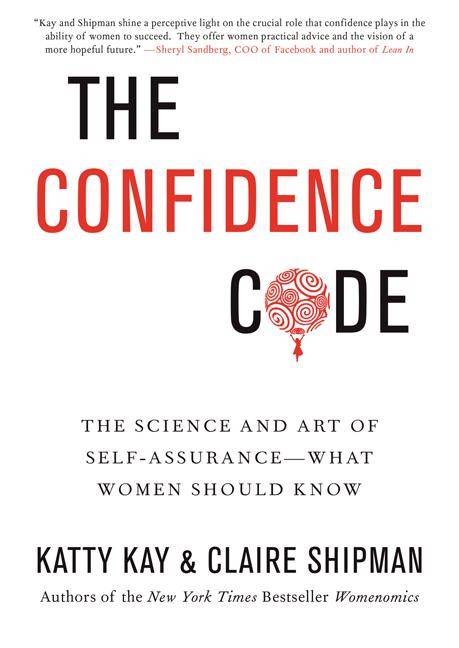
The Confidence Code by Katty Kay & Claire Shipman, 2014

I enjoy reading business and self-help books as a reminder of best practices.  Rarely do these types of books introduce a revolutionary new concept, but they do provide an updated point of view and reminder of best practices.

The Confidence Code instantly appealed to me since one of my professional weaknesses is lack of confidence.

Although discouraging, but not surprising, studies show that confidence matters more than competence when it comes to the corporate world.

Being perfect is not the way to get ahead in business, but being confident is.

Not that competency is irrelevant as there needs to be a high level of competency to make it to the upper echelons, but without a high level of confidence, the upper echelons will not be in grasp. 

While reading The Confidence Code, I flagged numerous quotes in an attempt to remind myself of how I need to shore up my confidence.  These quotes are posted in a separate blog post.

Books like The Confidence Code and Lean In are good to read since I see myself in the women described in the books and the first step to improving upon something, is recognizing the behavior. 

Reading the findings of studies of how women doubt themselves, tend not to speak up as much as men do, and underestimate their own knowledge, ability and performance, reminds me of when I was in my MBA classes and a few professors told me what a great job I had done on the mid-terms and wondering why I did not speak up more.

Because of my lack of participation, they were surprised at how well I had done.  By not speaking up, I was perceived as not intelligent or just not getting the material being covered.

One particular Marketing professor encouraged me and would look at me when starting class discussions, but I never had enough confidence to say anything, even though I had been praised and the professor had gone out of his way to give me a confidence boost.

Naturally, I thought the work that I did and the thoughts I had during my classes were nothing special or above average.

Even today, a decade later, I still have trouble recognizing and believing in my own abilities: that I understand things quickly, can extrapolate and look at something from different angles and come up with different solutions.

And, I'm still realizing, not everyone can do this...  That I am special and above average.  I have had numerous managers praise my performance and abilities, and yet, I still have trouble believing it and really internalizing it.

Clearly outlining their research and findings on confidence, Kay and Shipman find that although confidence is genetic, it is a trait that can be changed through behavior and they provide useful tips on boosting confidence.

Chapter titles that summarize their advice include:
It's Not Enough to Be Good
Do More, Think Less
Failing Fast and Other Confidence-Boosting Habits

The secret to cracking the Confidence Code can be summed up with the following:
  • If you only remember one thing from this book, let it be this: When in doubt, act.
  • Confidence is the stuff that turns thoughts into actions.
  • Think Less. Take Action.  Be authentic.

Lean In: Women, Work, And the Will to Lead by Sheryl Sandberg, 2013

Conversations about women in the workplace and women "having it all" are always controversial, mainly because the definition of "all" varies greatly for individuals, especially amongst women.

Sheryl Sandberg, Chief Operating Officer of Facebook and one of a few handful of female executives in the US, tackles this subject with a mix of personal experiences, and numerous sociological studies and corporate surveys about women and leadership.

The book does not uncover any new epiphanies or solutions, but creates a stir because of Sandberg's professional title. If Sandberg was a mid-level manager, the book would have barely gotten any attention since the "Mommy War" theme has been played out.

People talk about this book though, even if they have not read it.  She is bringing the conversation back in a positive way.  For this reason, I am glad that I read this book.

Ambitious with an impressive resume that includes The World Bank, Google and Facebook, Sandberg's definition of "having it all" clearly includes advancement in the workplace, which is one of the reasons why she and the book have come under attack.

However, if Sandberg's definition of "having it all" includes taking a demotion to spend more time at home with her children, she would also have come under attack. 

Bottom line, there is no point of view on this topic that will not be controversial, which is part of the problem that faces women when it comes to balancing their personal and professional lives.

Two things that I took away after reading this book:

1. Confidence - I need to work on my self-confidence and "lean in" at meetings and participate rather than leaning back and observing.

I am ambitious, have an MBA and am proactive, but my self-confidence needs work.  A particular pet peeve is that I do not speak up in meetings, or Lean In, and tend to make statements in the form of questions.

Part of the confidence is changing my physical being and exterior carriage by straightening my posture and leaning in to change how I feel. 

Similar to how Maisie Dobbs mimics the physical carriage of people to provide a better sense of what they are feeling, how one carries themselves is a reflection of how they feel, and vice versa.

2. Fulfillment - At times, I can see myself being a stay-at-home mom.  Even if that is to be the case though, Sandberg has made me realize that I should Lean In while I am still working.

I need to keep my foot on the gas and decide to ease up and focus on becoming a mother if and when the time is right.

An analogy from the book that resonates with me:

"Imagine that a career is like a marathon - a long, grueling, and ultimately rewarding endeavor.  Now imagine a marathon where both men and women arrive at the starting line equally fit and trained...  The male marathoners are routinely cheered on: "Lookin' strong! On your way!"

But the female runners hear a different message.  "You know you don't have to do this!" the crowd shouts.  Or "Good start - but you probably won't want to finish."  The farther the marathoners run, the louder the cries grow for the men: "Keep going! You've got this!"

But the women hear more and more doubts about their efforts.  External voices, and often their own internal voice, repeatedly question their decision to keep running."

[I had read this book in 2013, but neglected to complete the write-up.  Only after reading The Confidence Code by Katty Kay and Claire Shipman and wanting to reference this book while talking about the former, did I realize that I never completed this post...!

Since it's never too late as they say, I am posting this entry now, a year later.]

Tuesday, August 12, 2014

Save the Date by Jen Doll, 2014

A memoir of the weddings that Jen Doll has attended in her 20s and 30s, Save the Date is an odyssey of weddings. 

Wryly observational without any traces of self-pity or self-consciousness (despite throwing up into the reefs or throwing shoes), Doll's memoir is a fun, entertaining read.

The memoir captures the feeling of attending weddings in your 20s when it's a college reunion and a little surreal that peers are making such an important "adult" decision. 

After a few weddings and over a few years, friends couple off and weddings become a bit more of a social chore. 

The celebration of love and happiness (and open bar) are still there, but weddings become a reflection of Doll herself as she matures.

Never bitter or wishing that she was married, Doll reaches the point where going to wedding with a date becomes easier.  Even if the date is someone she just met that night and that she was seated next to.

Because of Doll's wry personality, exuberance and love of a story as a friend proclaims about Doll, Save the Date is filled with entertaining stories, silly fights from younger days and drunken escapades throughout.

One of the more touching stories is a wedding the 30-something Doll attends as a guest of a 20-something man that she has been dating.  All is fine until the after-party when Doll's date starts playing beer pong.

Reading the tale, I roll my eyes, but Doll talks about how she playfully sits and laughs with her date's friends as they watch the boys play beer pong before heading off to bed late into the night.

The reality though, Doll admits, is that fueled by alcohol, she approaches her date, throws the ping pong offered to her at the wall, and yells at him that she hates beer pong.  She hates him.  Then storms off.

Destination weddings, a wedding at city hall, and a wedding she attends as a reporter covering the first gay marriage in the state of New York officiated by Mayor Michael Bloomberg, Doll covers a lot of ground, never making the memoir too repetitive or even predictable, despite knowing that the next chapter will be about a...wedding!

A quote from the book that resonates with, and pleases me:

"One of the benefits to having a wedding in your midthirties or beyond is that a lot of the rules and traditional expectations cease to matter in the slightest.  You have the confidence and the financial standing to do it your own way, and that makes it all the better."